Most five-inch filter slots we open in Central Florida homes have a one-inch filter rattling around inside, shimmed in place with cardboard or a strip of foam. That deep slot was built for a thicker filter, and the thicker one is what actually protects your blower. The reason comes down to resistance. Your motor pulls against whatever filter sits in front of it, and a thin panel in a deep slot makes that pull harder than it ever needed to be.
We have pulled enough tired blower motors over the years to trust what the cabinet is telling us. The American Standard 17.5x27x5 air filters FLR06069 slot was sized around a deeper, higher-surface-area filter on purpose. Set that five-inch pleat next to a flat one-inch air filter, and the deep media spreads the same airflow across far more surface, so your motor moves the air it needs without straining for it.
TL;DR Quick Answers
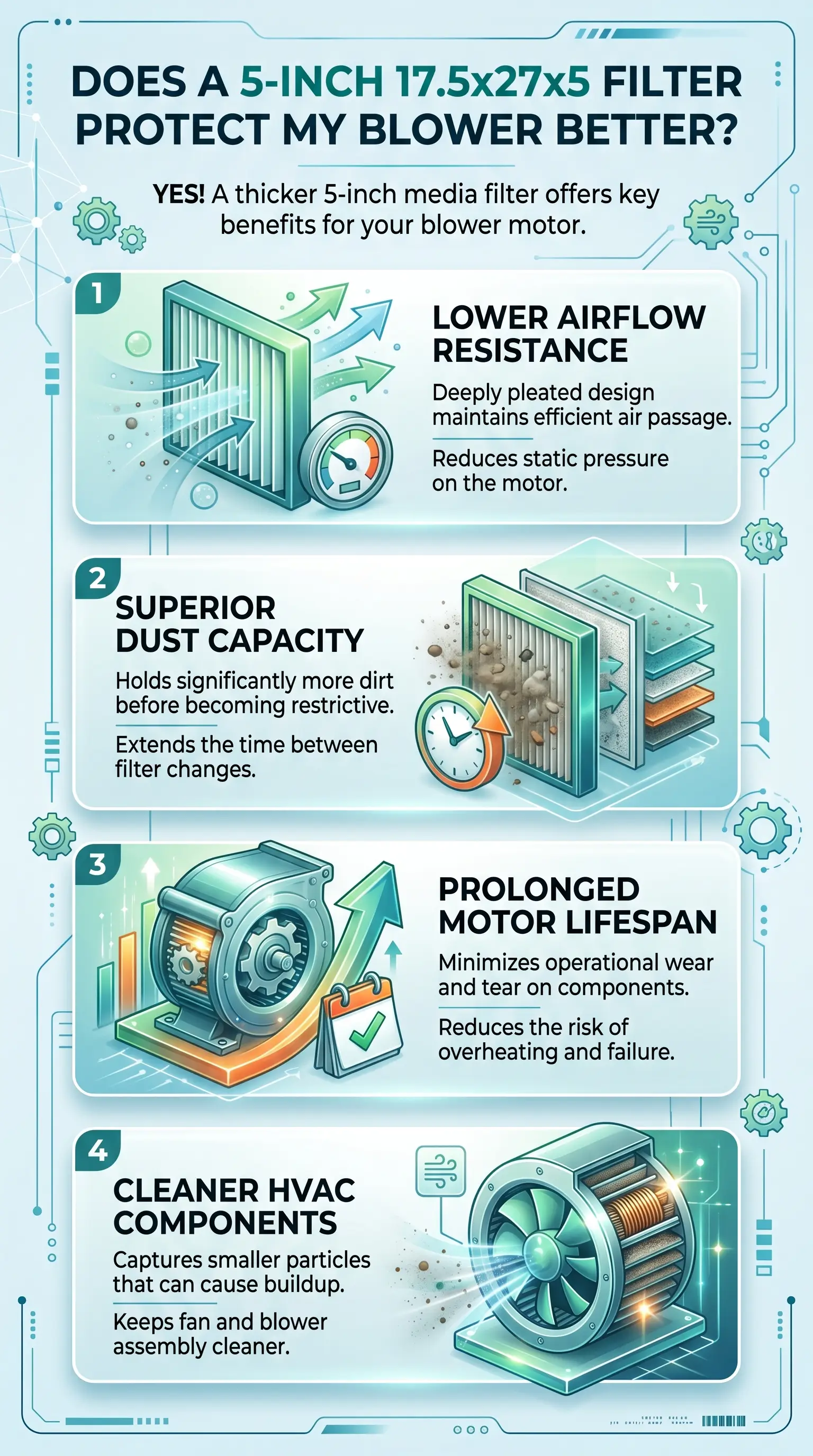
Does a 5-inch 17.5x27x5 protect the blower better?
Yes. The deeper pleat gives the air more surface to pass through, so your blower works against less resistance than it would with a one-inch filter.
Does it fit every system?
No, and this is the part homeowners miss. It needs a true five-inch media cabinet, the kind that fits American Standard and matching Trane returns. If you are not sure what you have, start by matching your filter size.
Which MERV should I run?
MERV 8 covers most homes. Go to MERV 11 if allergies are in the picture, or MERV 13 for the finest particles, as long as your fan can pull through it. A minute spent understanding MERV ratings settles the question, and you swap the filter about every 90 days.
Top Takeaways
- A five-inch filter spreads airflow across more surface, so your blower works against less resistance and you get deeper dust protection.
- More depth means more dust-holding capacity. That protects the motor and coil and helps you avoid costly repairs while stretching each filter to roughly 90 days.
- It fits cabinets built for five-inch media only, matched to American Standard and Trane returns.
- MERV 8 suits most homes, MERV 11 helps with easing allergy symptoms, and MERV 13 catches the finest particles when your fan can handle it.
- A filter your system cannot pull through protects nothing. Fit and capacity come first.
What the extra four inches actually does
Picture the same air pushed through two screens, one the size of a paperback and the other the size of an open road map. The small screen forces the air to speed up and shove through, and that speed is what your blower feels as resistance. A five-inch 17.5x27x5 holds several times the pleated surface of a one-inch panel, so the air slows as it passes and reaches the rest of the house as cleaner whole-home air. Slower air means lower static pressure across the filter, and lower static pressure means your blower draws less current to do the same work.
The one-inch trade-off we see most
Put a one-inch filter in a high-MERV rating and it clogs within a few weeks, choking the airflow your system depends on. From there, most homeowners either run a strained system or fall back to a cheap fiberglass panel that catches almost nothing, when a pleated option would give them cleaner everyday airflow. A deep filter skips that whole cycle. It holds far more dust before it loads up, which is why it runs on a 90-day rhythm and why it is easy to keep replacement filter options on the shelf instead of changing one every month.
Will it fit your system?
Here is the honest caveat, and we bring it up on a lot of service calls. A five-inch filter only helps in a cabinet built for it, seating cleanly in American Standard and matching Trane five-inch slots with no gaps for air to sneak around. A one-inch return will not take it, and forcing more resistance than your fan was rated for works against the motor you are trying to protect. When the size you need is hard to find, custom filter sizing and a solid guide to sizing hard-to-find filters take the guesswork out of it. Federal guidance says the same thing in plainer words: run a filter as efficient as your system allows, and check your equipment’s capacity first.
Picking a MERV that protects without choking
We carry three options in this size, and the right one depends on your household more than any spec sheet. In our own product testing, the MERV 8 catches about 90% of the airborne particles we measure, the MERV 11 about 95%, and the MERV 13 about 98%. For most homes, a MERV 8 keeps dust and lint off the blower wheel and coil, and a good pleated filter will trap more household dust than the panel it replaces. Step up to MERV 11 when someone in the house fights allergies, or MERV 13 when you want help filtering wildfire smoke and the smallest particles, provided your blower has the muscle to pull through the denser media.
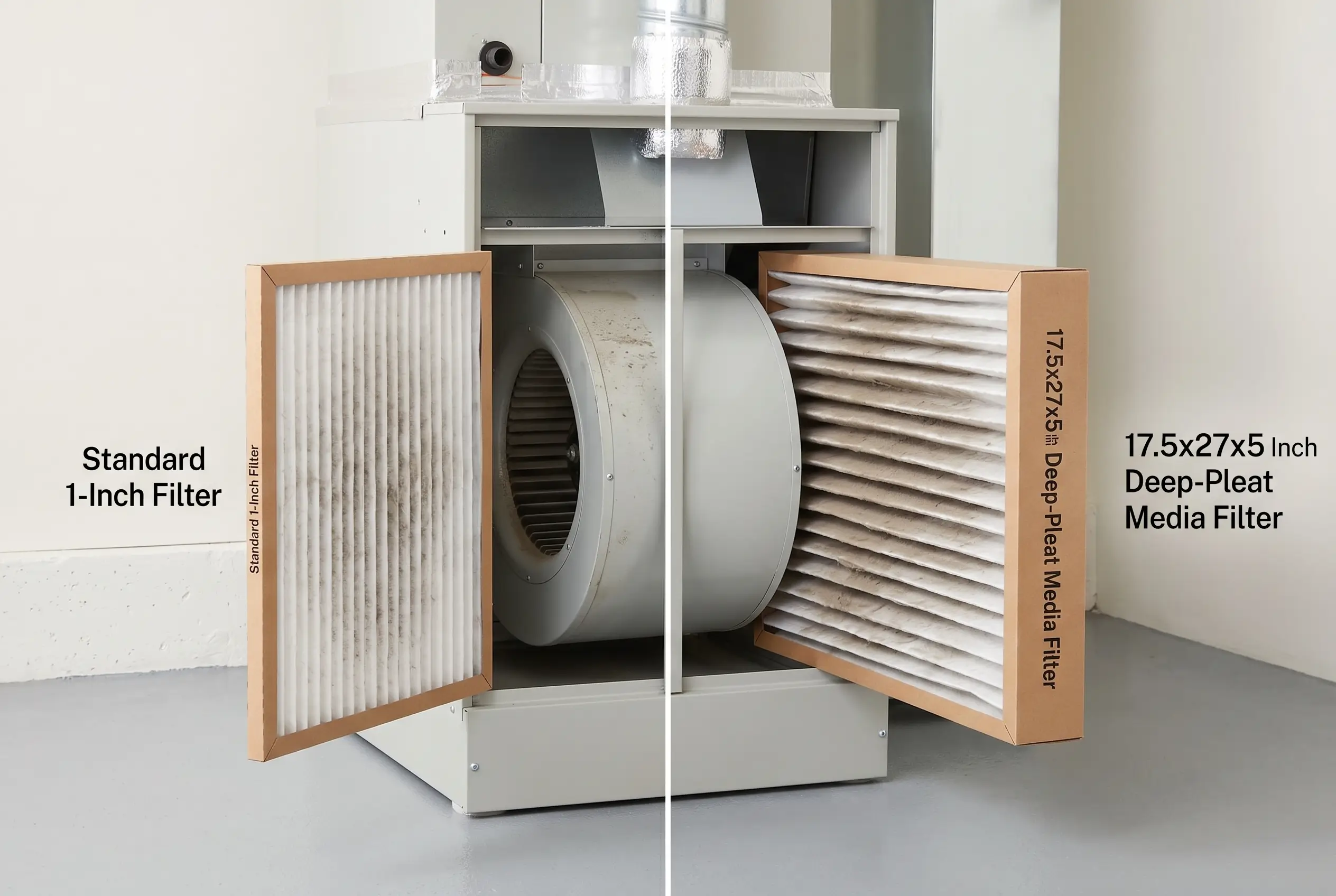
“The filters we pull from five-inch cabinets that have been running a one-inch panel almost always come out with the pleats collapsed toward the blower. That collapse is the motor telling you it has been working too hard for too long.”
7 Essential Resources
- EPA — Guide to Air Cleaners in the Home: how MERV ratings work and why you should match filter efficiency to your system’s fan and slot.
- U.S. Department of Energy — Air Conditioner Maintenance: how dirty, clogged filters cut airflow and let dirt bypass onto the coil.
- ENERGY STAR — Heat & Cool Efficiently: a simple schedule for checking and changing filters before airflow drops.
- American Lung Association — Air Cleaning: how HVAC filters clean the air only while the fan runs, and what a MERV upgrade means for health.
- CDC (NIOSH) — Improving Air Cleanliness: guidance on filter efficiency, proper sizing, and staying within service life.
- U.S. Energy Information Administration — Home Heating and Cooling Energy Use: how large a share of your home’s energy the HVAC system carries.
- NADCA — Homeowner Cleaning Methods: how a clean filter fits into keeping the whole system free of debris.
3 Statistics
- We bring up the filter because of where you actually spend your time. The EPA puts it at roughly 90% of the day indoors, where some pollutants run 2 to 5 times higher than the air outside. (EPA, Indoor Air Quality)
- The blower you are protecting runs your biggest energy load. ENERGY STAR pegs nearly half of the average home’s yearly energy bill, more than $900, on heating and cooling. (ENERGY STAR)
- Cooling alone is a heavy draw. The U.S. Department of Energy estimates air conditioners eat about 12% of the electricity used in U.S. homes, close to $29 billion a year nationwide. (U.S. Department of Energy)
Final Thoughts and Opinion
If your cabinet is built for five inches, our opinion is not a close call. A five-inch 17.5x27x5 in the right MERV protects your blower better than any one-inch filter you can wedge into that slot, because it lets the motor move air against less resistance while still defending against airborne dust. The one rule we never bend is fit. Match the depth to your cabinet and the MERV to your fan’s capacity, and the deep filter quietly does its job for about three months at a time while giving you fresher indoor air. Force in a filter your system cannot pull through, and you have simply traded one problem for another.
Frequently Asked Questions
Does a thicker filter really reduce blower strain?
Yes. More pleated surface lowers the speed and pressure of the air moving through the filter, so the blower draws less to push the same volume. We see the difference on systems running deep filters that fit the way they should.
Will a 17.5x27x5 filter fit my system?
Only if you have a five-inch media cabinet. It is sized for American Standard and matching Trane five-inch slots. If your return takes a one-inch filter, this size will not go in.
Which MERV is safe for my blower motor?
For most homes, a MERV 8 is the easy, motor-friendly pick. MERV 11 and 13 catch more, and they are safe as long as your blower can pull through the denser media. When you are unsure, start at MERV 8 or 11.
How often should I change a five-inch 17.5x27x5 filter?
Figure on about every 90 days. Pets shorten that, so if you are focused on capturing pet dander, check it monthly and swap it once the pleats look loaded.
What are the signs my blower is fighting a clogged filter?
Weak airflow at the vents, longer run times, a house that will not hold its temperature, and pleats pulled toward the blower. While you have airflow on your mind, clearing dryer vents keeps one more path in the house from backing up.
Where can I find the right FLR06069 size?
Match the exact size, then choose your MERV, on the product page linked up in the introduction.
Find Your Fit With Us
If your cabinet is built for five inches, the surest way to protect your blower is to put back the filter that slot was made for.
Learn more about HVAC Care from one of our HVAC solutions branches…
Filterbuy HVAC Solutions - Miami FL - Air Conditioning Service
1300 S Miami Ave Apt 4806 Miami FL 33130
(305) 306-5027
https://maps.app.goo.gl/Ci1vrL596LhvXKU79